
When school strikes burn more than buildings. Why virtual schools may be Kenya's best solution.
Perhaps it is time Kenya seriously considers a solution that has quietly been growing across the world: virtual schools.
The images were heartbreaking. Dormitories reduced to ashes. Mattresses blackened by smoke. Students standing outside in shock, some with nothing left but the uniforms on their backs. Once again, Kenya woke up to news of another school fire, another interrupted term, another traumatized group of students, another family wondering whether their child is truly safe at school.
Sadly, school fires and strikes have become painfully familiar in Kenya. Every few months, parents hold their breath as headlines announce unrest in schools, damaged property, injuries, or even loss of lives.
Perhaps it is time Kenya seriously considers a solution that has quietly been growing across the world: virtual schools.
School strikes are often treated as discipline problems. But the truth is, they are usually symptoms of deeper issues: pressure, overcrowding, lack of emotional support, rigid systems, poor communication, and environments where students feel unheard.
When schools close due to unrest, learning stops immediately. Parents are forced into emergency planning. Candidates panic over lost time. Teachers struggle to recover syllabuses. Some students never emotionally recover from the trauma.
And it is not just fires. Flooding, insecurity, transport challenges, illness outbreaks, and even nationwide disruptions have shown how fragile traditional learning systems can be. One disruption can derail an entire academic calendar.
This is where virtual learning changes the conversation. A child's education should not depend entirely on whether they can physically access a classroom building every single day.
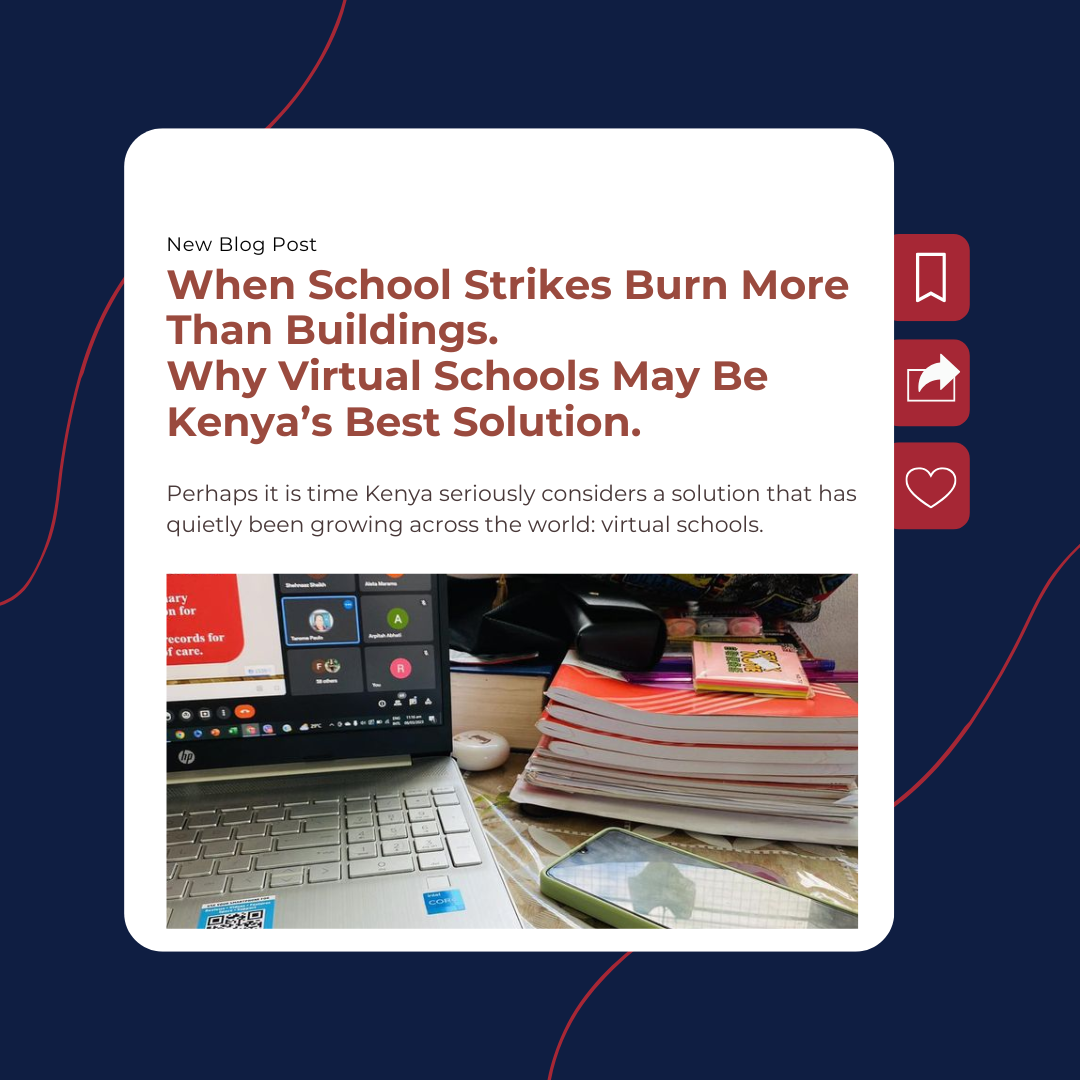
Virtual schools provide continuity. Students can continue learning safely from home, access recorded lessons, attend live classes, submit assignments online, and interact with teachers digitally. Instead of entire terms collapsing due to strikes or unrest, learning simply continues.
For parents, this means less anxiety. For students, it means stability. For teachers, it means flexibility and uninterrupted progress. Most importantly, it removes children from environments that may become emotionally or physically unsafe.
A few years ago, virtual schools sounded impossible in Kenya. Today, things are different. Internet access has expanded rapidly. Smartphones are common even in many rural households. During school closures in previous years, many Kenyan parents and teachers discovered something surprising: children can learn effectively online when systems are properly structured.
Virtual schools are not the enemy of physical schools. Children still need friendships, sports, mentorship, teamwork, and social interaction. Physical learning spaces still matter deeply. But Kenya must stop thinking of education as only one thing. The future is hybrid.
Our children deserve an education system that can survive disruption. Virtual schools may not solve every problem in Kenya's education sector. But they offer something our current system desperately needs: flexibility, safety, continuity, and resilience.
Curious if Brainybay could be a fit for your child?